Rules, Superseded

Let’s talk about how strictly we OCD people adhere to rules. More to the point, let’s talk about how that adherence closely relates to—and naturally derives from—mankind’s overall affinity for prescribing (and proscribing) behavior.
Before we focus on OCD, let’s just consider people in general. Humans put a lot of stock in rules, don’t we? All kinds—everything from simple line etiquette (“I got here first, so I’m ahead of you”) to convoluted tax laws. We love to cite them when someone crosses us, and we love to feel superior when we follow them better than the next guy.
Mostly, though, we live by them. Sometimes tenuously, sure, but we do. They’re the guardrails that keep us on the road. They not only enable us to live peaceably together, but to govern our own selves. If we were bats sending out echolocator signals, rules would be the bounce-back that keeps us from flying into cliffs.
Have you ever thought about how mankind started making rules in the first place? It’s simple, and we see it reenacted over and over: Someone surprises us with a bad behavior we hadn’t anticipated, so we make a rule. “Huh. That guy just took something without paying. That seems wrong. There should be a rule.” Over and over, just like that, throughout history.
For millennia, even God’s relationship with mankind was defined by rules. We could never follow them, of course, so our history is full of apologizing, sacrificing something dear to us to make amends, then promising to straighten up and fly right. Eventually, God said “enough” and stepped in with a once-for-all-time solution we couldn’t have provided for ourselves. Indescribably gracious of Him. “There—that’s finished,” He said. “Going forward, just come to my side and emulate me. You’ll see—the more you become like me, the more you’ll discover that you don’t need rules. You’ll become so much like me that they’ll be superfluous.”
And that should have been the end of the rules story . . . only it wasn’t. We kept making them.
Now let’s segue gently into OCD. Hang with me. Maybe you’ll even catch my drift before I get there.
Back in the Apostle Paul’s day, he got word that the church he’d planted in Galatia was backsliding into rules-following. Instead of simply living anew in the freedom God had provided through Christ, the Jewish converts to Christianity—slow to leave their old ways—were demanding that “pagan” converts become more like Jews. Possibly because it just seemed too easy, they didn’t think a pagan could become a Christian without (kind of) going through Judaism first. They had to pay their rules-following dues.
Paul got pretty upset about that, as you’d imagine, so he mailed the Galatians a stern letter. “It is for freedom that Christ has set us free,” Paul wrote (Galatians 5:1, NIV), likely in both admonishment and exasperation. “Stand firm, then,” he continued, “and do not let yourselves be burdened again by a yoke of slavery.”
Paul used a telling word to sum up the senseless rules the Galatian church was falling back on: flesh. Rules were fleshly. Human-derived. Old-timey leftover crutches from the rule-following era. “You, my brothers and sisters, were called to be free,” Paul said further along in the letter (Galatians 5:13). “But do not use your freedom to indulge the flesh.” Flesh, in short, had been superseded by Spirit—by Jesus’ reconciling act, which amounted to God’s invitation to come alongside Him, emulate Him, and let Him live through us. If we did the second one, there was no need for the first. One obviated the other.
See the OCD implication? Paul went on to caution, in essence, “You wanna know what you’re dabbling in when you act like grace never happened and go back to imposing rules on yourselves? Fine. I’ll elaborate.” And he proceeded to list the inevitable, nasty outcomes that came from the old rules system—can’t-avoid-them fleshly failures like sexual immorality, idolatry, jealousy, selfish ambition, envy. Those are the things we’ll run into when we try to contain the flesh with rules. We lock ourselves in a self-designed prison.
But when we come alongside God and let His Spirit reshape us from within, something totally “other” happens: Instead of trying to prevent bad things with guardrails, we begin naturally exhibiting things like love, joy, peace, kindness and—a big one for us OCD folks—self-control. We can still put up all the guardrails we want, but it’s a waste of time—if God’s Spirit is pouring out of us, we may as well write rules for the wind to follow. That’s why Paul says, at the end of his list of Spirit-inspired virtues, “Against such things there is no law (verse 23).” In other words, when the Spirit is producing these virtues, rules have nothing left to condemn, restrain or correct. There’s just nothing for rules to do anymore.
OCD is rules-based. It’s totally rules, right? Self-imposed rules. We say to ourselves, “Do this, or something bad will happen.” Or, “Follow your rule until everything feels right.” When we indulge OCD, we’re just like the Galatians Paul wrote to, trying to supplement and complicate what’s supposed to be an unburdened life covered by grace with fussy, needless laws dictating our thoughts and behavior. OCD is a dictating authoritarian, and an unkind authoritarian at that. But the simplistic human part of us that’s drawn to rules submits.
Here is the understanding we Christian OCD sufferers must adopt: Rules go silent as the Spirit increases. The answer isn’t to follow the rules perfectly. That cannot be done, and history has proven it over and over—no exceptions. Rules fail us. We fail them. The answer is to get away from the whole rules-following dead end and, instead, let God’s Spirit build within us things that no system of rules can put boundaries around.
A simple illustration before we finish. When I was a kid, my parents wanted my bedroom clean. It was a rule, and it chafed. I’d rather have played with my Hot Wheels or watched Gilligan’s Island, so they had to get on me about it. “This is the rule. You will abide by it!” Ugh. So I’d follow the darned rule, but I didn’t have to like it. What awful drudgery! But then—maybe on a day when Dad took me to Baskin-Robbins, or Mom got me some new Crayons—I’d think fondly about my parents and—gasp!—clean my room on my own recognizance. The weird result: I was happy—eager, even—the entire time I was cleaning! I knew how pleased my parents would be. And sure enough, when they praised me, their pleasure became my pleasure, and I became excited to incur that pleasure again. Then guess what? The rule about keeping my bedroom clean . . . just kind of fell by the wayside. There was no need.
The Fruit of the Spirit—exemplified just now in my pleasurable, love-driven desire to clean my room—naturally and unobtrusively pushes aside the flesh and its impossible tangle of rules. In essence, with a dismissive hand gesture, Spirit makes flesh obsolete.
I urge you, OCD sufferer, to test this phenomenon. Spirit and flesh are incompatible. As one increases, the other decreases. So, more and more, accept God’s gracious provision and quit trying to provide for yourself. Let His Spirit dwell and grow within you through regular Bible study, church attendance, and hanging out with supportive Christian friends. As you do these things with enthusiasm and gratitude, that enthusiasm and gratitude will spread to other aspects of your behavior—perhaps, even, the ones that have been entrapping you. As that happens, you’ll discover that you’re starving your rules to death.


Welcome, I'm Rob Johnson!
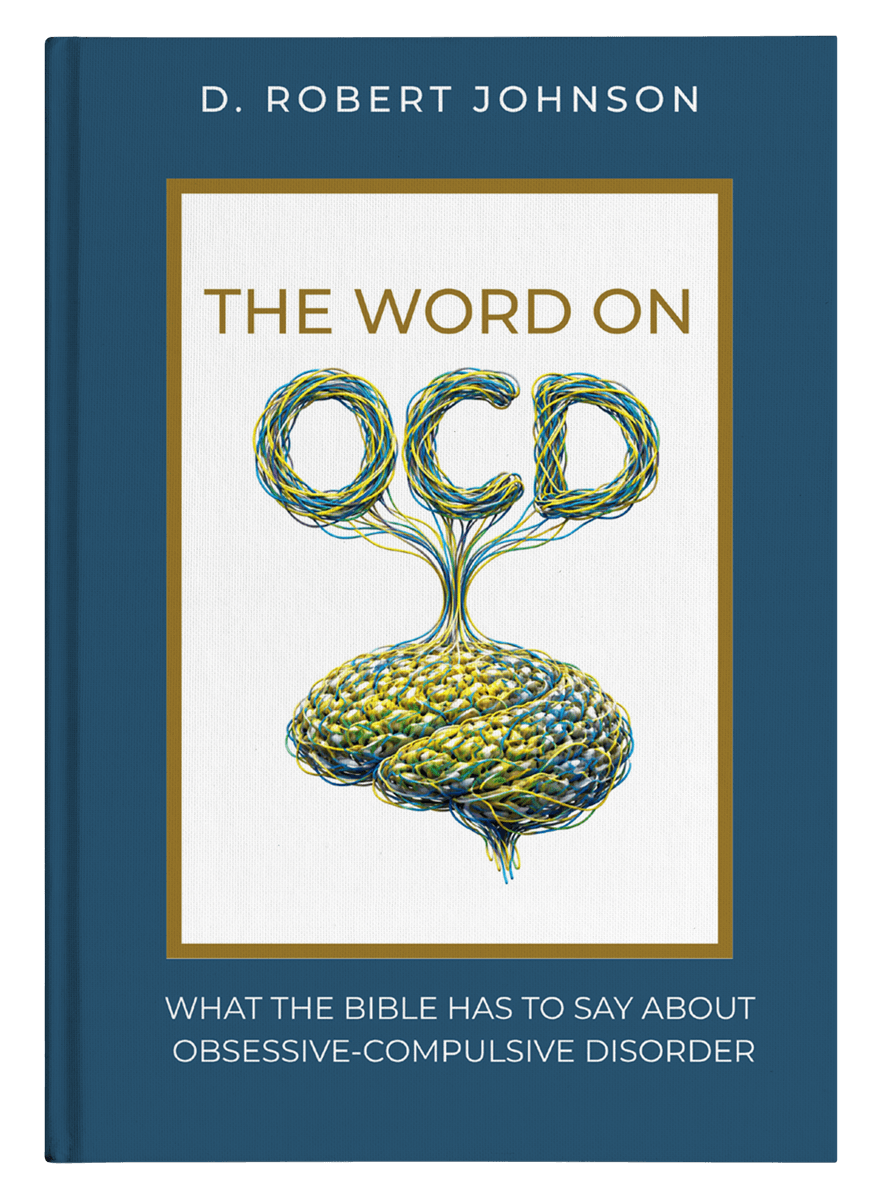
I tried hard to pack The Word on OCD: What the Bible Has to Say About Obsessive-Compulsive Disorder with a comprehensive look at how the Bible integrates meaningfully with both medicine and therapy in treating Christians with OCD. I have ongoing thoughts on the subject, though, and I’ll bet you have ongoing questions, too. To help with both challenges, I’ve created a blog. Take a peek! When I’ve got something new to say—or when I’m answering a question you’ve asked—I’ll drop a new blog post. Be sure to check back regularly, as I add a new post every week or so!
Search the Blog
Check out the Book here